


Comparing investments can be confusing.
One fund may have produced the highest recent return. Another may charge lower fees. A third may appear more stable when markets fall.
So which one is better?
The answer is that an investment should rarely be judged on performance alone.
A useful comparison should consider the return you actually receive after fees, the amount of risk being taken, how the portfolio is invested and whether the investment remains appropriate for your financial goals.
This becomes particularly important as you approach retirement and your accumulated savings become one of your most important financial assets.
If you already have a Retirement Annuity, Preservation Fund, Living Annuity or investment portfolio, Investonline can provide a free personalised comparison of your current position, including fees, fund performance and investment strategy.
Get your free Investment Health Report or get your Free Comparison
What should you compare when looking at investments?
A good investment comparison should look at several factors together.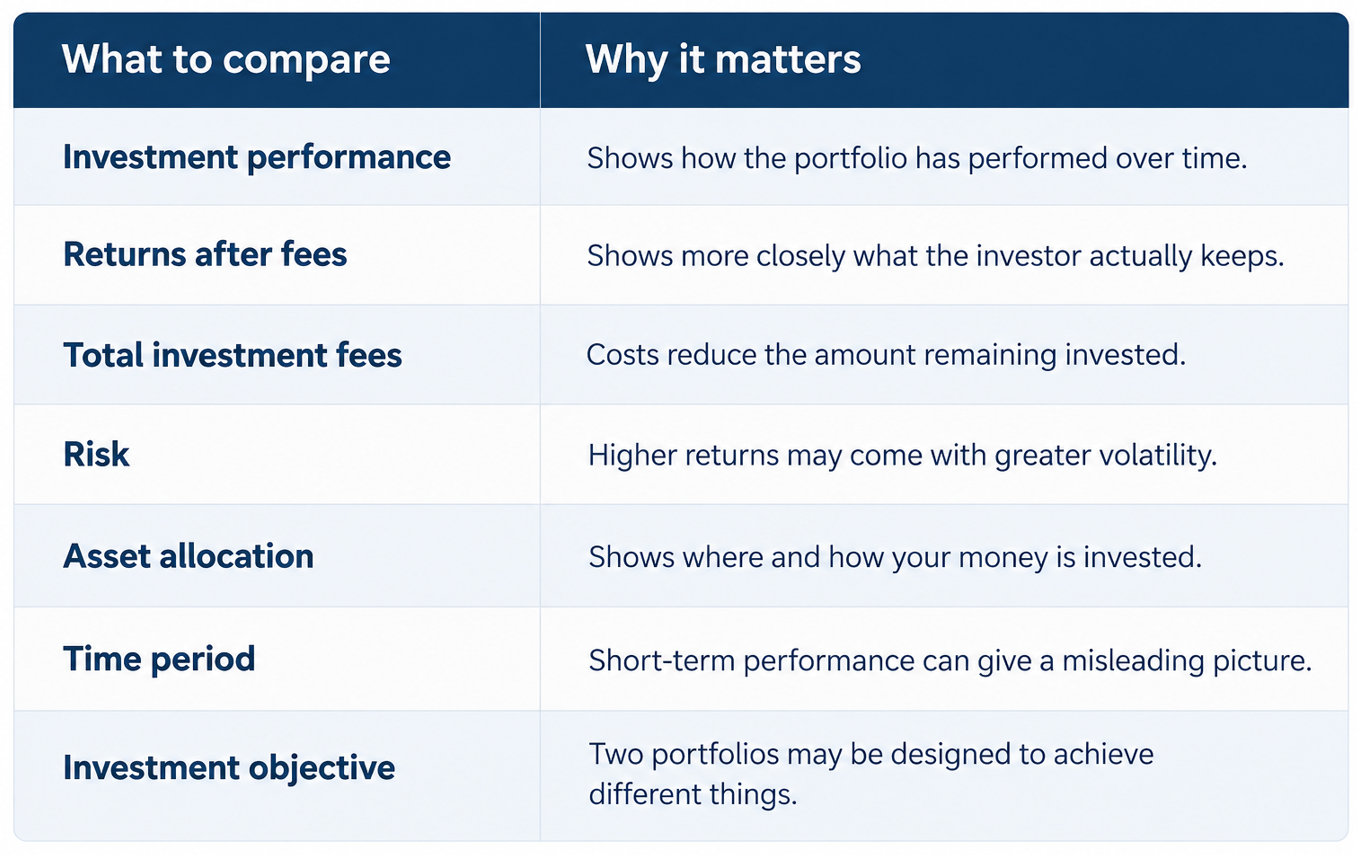
The key is to compare like with like.
For example, comparing a cautious income portfolio with a high-equity growth portfolio purely on returns would not be meaningful. They are designed for different objectives and carry different levels of risk.
How should you compare investment performance?
Investment performance is important, but the period you look at matters.
A fund that performed well over one year may not have performed as consistently over five or ten years.
Where sufficient history exists, look at several periods rather than one:
- 1 year
- 3 years
- 5 years
- 10 years
For periods longer than one year, investment platforms commonly present performance as an annualised return. Moneyweb, for example, annualises unit trust and ETF performance for periods exceeding 12 months.
Longer periods can provide useful context because they may include different market environments rather than one unusually strong or weak year.
However, historical returns still cannot tell you exactly what will happen next.
Past performance does not guarantee future returns.
Compare returns after fees, not just headline performance
This is one of the most important points when comparing investments.
Imagine two similar investments both achieving a 10% return before certain costs.
If one investment ultimately costs more each year, less of that return remains invested for you.
Over long periods, the difference can compound.
This is why Investonline’s comparison process focuses on returns after fees, rather than looking only at headline fund performance. The comparison also reviews the investment’s fee structure and underlying fund performance.
When comparing investments, ask: What return did the portfolio generate?
Then ask: What did I actually receive after the costs of investing?
Those are not always the same number.
Compare the total investment fees
Most portfolios can contain several layers of fees.
These may include:
- investment or fund-management fees
- platform or administration fees
- financial adviser fees
- transaction costs
- performance fees where applicable
Looking only at one fee can therefore be misleading.
For example, an investment may advertise a relatively low fund-management fee but still have administration and adviser costs added elsewhere.
Where possible, look at the total cost of the investment and understand what each fee is paying for.
If you’re unsure how investment fees work, read our complete guide to Investment Fees in South Africa.
Compare Your Current Investment Fees and Returns
Active versus passive investments
Another common mistake is comparing active and passive investments without considering what each strategy is trying to achieve.
Passive or index investments generally aim to track a market or index at a relatively low cost.
Active investment managers make investment decisions about which assets to buy, hold or sell and generally charge more for that management.
Neither is automatically better.
Investonline itself uses a combination of active and index strategies depending on the portfolio and investment objective.
A useful comparison therefore asks: What am I paying, what strategy am I receiving, and what has that strategy delivered after costs?
Investment returns should be compared with risk
Higher returns can sometimes simply mean that more risk was taken.
That is why comparing only the final return number can produce the wrong conclusion.
When assessing investments, consider factors such as:
- equity exposure
- offshore exposure
- volatility
- maximum drawdown
- diversification
- overall risk profile
EasyEquities’ unit trust comparison tool, for example, includes performance alongside fee data and risk measures such as standard deviation and maximum drawdown.
This is particularly relevant for someone approaching retirement.
A 35-year-old accumulating retirement savings may be able to tolerate significant market fluctuations.
A 65-year-old drawing income from a retirement portfolio may have very different requirements.
The appropriate investment is not necessarily the one with the highest historical return. It is the one whose expected risk and return characteristics are suitable for your circumstances.
Why asset allocation matters when comparing investments
Two investments can have similar names but completely different underlying portfolios.
One may hold 70% or more in equities while another may have considerably more exposure to bonds and cash.
Others may have greater offshore exposure.
These differences affect both potential return and risk.
Before comparing two portfolios, look at:
- Equities: How much is invested in shares
- Offshore assets: How much is invested outside South Africa?
- Fixed income: How much is invested in bonds and income-producing assets?
- Cash: How much is held in lower-risk cash instruments?
Your comparison becomes far more useful when portfolios with similar objectives and risk profiles are placed alongside one another.
Should you simply choose the investment with the highest return?
No.
The investment that produced the highest return over the last year is not automatically the best investment for you.
A strong investment decision should consider: performance + fees + risk + diversification + your financial objective
Rather than performance in isolation.
The same principle applies when looking at lists of top-performing unit trusts.
Moneyweb’s unit trust data, for example, allows investors to view returns alongside total expense ratios and performance fees, providing more context than a performance ranking alone.
How do you compare two retirement investments?
If you are comparing Retirement Annuities, Preservation Funds or Living Annuities, the comparison should extend beyond the underlying investment fund.
Consider: Fees
What is the total cost of the investment?
Investment performance
How have the underlying portfolios performed over comparable periods?
Risk
Are you comparing portfolios with similar investment objectives?
Investment strategy
Is the portfolio properly diversified across asset classes and markets?
Product rules
Does the product work appropriately for your stage of retirement?
Advice
Are you receiving ongoing financial planning and is that service providing value?
Investonline’s comparison report specifically considers product rules, fee structure, investment performance and risk rather than looking at one number in isolation.
Why comparison matters more when you have R2 million or more invested
Small percentage differences become meaningful amounts of money when your portfolio grows.
For example:
- 1% of R2 million = R20,000
- 1% of R5 million = R50,000
- 1% of R10 million = R100,000
That does not mean a more expensive investment is automatically worse.
It means the difference should be justified.
If one investment costs more, you should understand what you are receiving for that additional cost and whether the outcome justifies it.
The same principle applies to performance.
A seemingly small difference in annual net returns can become substantial when compounded over many years.
That is why investors approaching retirement should periodically compare their current portfolio rather than simply assuming the investment they selected years ago remains the best fit today.
When should you review and compare your investments?
Consider reviewing your portfolio when:
- you are approaching retirement
- your retirement savings have grown significantly
- you have not reviewed the portfolio for several years
- you do not know your total investment fees
- your investments appear to be underperforming
- your risk profile or financial circumstances have changed
- you are considering changing investment providers
- you want an independent second opinion
A review does not necessarily mean you should switch investments.
Sometimes the conclusion may be that your current arrangement remains appropriate.
The point of the comparison is to give you enough information to make that decision properly.
How does an Investment Comparison Report work?
With Investonline’s free comparison, your existing investment can be assessed using information from your current portfolio and investment statement.
The comparison can help you understand:
- Your current investment performance. See how the underlying portfolio has performed.
- Your current fees. Understand what you are paying.
- Returns after fees. Look beyond headline performance to the result after investment costs.
- Risk. Assess whether the portfolio strategy is appropriate for you.
- Investment structure. Understand how your existing product and portfolio compare with alternatives.
Investonline says its free comparison covers the product rules, fee structure and actual fund performance of the existing investment, together with risk assessment.
For the most accurate comparison, having your latest investment statement available is helpful.
Don’t compare investments on one number
There is no single number that tells you whether an investment is good.
A useful comparison considers the complete picture:
- What did it return?
- What did it cost?
- How much risk was taken?
- How is the portfolio invested?
- Is it still right for what I need my money to achieve?
That is particularly important when the investment represents years of retirement savings.
An independent comparison can help you understand where you stand before deciding whether any changes are necessary.
Get Your Free Investment Comparison Report
Investonline’s financial planners can review your existing Retirement Annuity, Preservation Fund, Living Annuity or investment portfolio and provide a clearer view of the fees, performance, risk and investment strategy.
Frequently asked questions
How do I compare investments in South Africa?
Compare investments using similar time periods, investment objectives and risk profiles. Look at historical performance, total fees, risk, asset allocation and returns after fees rather than simply choosing the investment with the highest recent return.
What is the best way to compare investment performance?
Look at several periods such as one, three, five and ten years where available. Longer-term performance can provide more context than a single year, but historical results do not guarantee future performance.
Should I compare investments before or after fees?
Both are useful, but returns after fees can provide a clearer picture of the result ultimately available to the investor.
Is the cheapest investment always better?
No. Lower fees can improve the amount left invested, but cost should be considered alongside performance, risk, service and the investment strategy being provided.
Should I switch if another investment performed better?
Not necessarily. Performance can vary considerably from one period to another. Before switching, consider whether the investments have comparable risk, objectives, fees and asset allocation.
Can I compare Retirement Annuities?
Yes. A meaningful Retirement Annuity comparison should consider underlying investment performance, total fees, investment strategy, risk and the relevant product structure.
Can I compare Living Annuities?
Yes. Living Annuity comparisons should consider fees and investment performance as well as income requirements, drawdown strategy, risk and the sustainability of retirement capital.
Where can I get an independent investment comparison?
Investonline offers a free comparison that reviews your existing investment’s fees, fund performance, risk and product structure.
Take the next step
Want a second opinion on your existing investments?
Request an Investonline Investment Health Report to review your portfolio’s costs, performance and advice and identify areas that may deserve closer attention.
Planning for retirement?
Use the Investonline Retirement Calculator to see how your current savings, retirement age, income needs and assumptions could influence your future retirement income.
