


ETFs (Exchange Traded Funds), commonly known as index or passive funds, have become increasingly popular over recent years. Their popularity is largely due to low management costs, which are broadly around 0.5% per annum lower than actively managed funds.
Passive ETF investments track a specific investment market index with no active stock selection or tactical trading. Apart from offering lower management fees, investors may appreciate their simplicity and transparent characteristics.
Globally, the flow into passive funds has increased significantly over the last 20 years, with more money now in passive versus active funds in the US. In SA, passive comprises around 10% of the unit trust market mainly due to the highly concentrated SA equity market. Four big companies make up 40% of the SA equity market, which significantly increases diversification risk.
US Passive Fund Market Share

Many investors assume that purchasing a few ETFs automatically provides broad diversification. Practically, the picture is more nuanced. Passive ETFs simply track an index and, while they provide market exposure, they do not provide true diversification on their own. Key risks include concentration in a few large holdings, sector overlap and a high correlation to market movement, which can significantly affect portfolio outcomes.
Below, we outline a few risks and explain how we work with clients to mitigate them.
1. Hidden concentration risk
The world’s most popular ETF, the S&P 500, comprises 500 companies, of which a third of its value is concentrated in just 8 mega-cap shares — including Apple, Microsoft, Nvidia, Amazon, Alphabet, Meta, and Tesla.
This means that approximately a third of your “diversified” U.S. allocation is effectively a bet on large-cap technology. When these stocks rally, as they did in 2023–2024, portfolio performance appears strong. However, when they experience a correction, such as 2022 when the S&P500 fell by over 20% in 9 months, the index was materially affected.
South African investors face a similar challenge. Local ETFs tracking the JSE Top 40 often have heavy exposure to a few dominant companies — for example, Naspers and Prosus together make up around 18% of the index and Gold Field 9% and Anglogold Ashanti 6%. This means a third of the index is concentrated in just three shares or just two sectors, creating significant concentration risk despite appearing diversified.
2. Overlap across ETFs
Owning multiple ETFs doesn’t automatically result in better diversification. Many global and index-tracking ETFs often hold the same top underlying stocks, meaning investors may be more concentrated than they realise.
Let’s look at a practical example:
Investor A decides to invest offshore by splitting capital equally across three ETFs tracking the S&P 500, Nasdaq 100 and MSCI World Index.
The table below shows the top 10 holdings within these three indices. As illustrated, nine of the top ten stocks overlap across all three indices. The only difference is in the 10th share – Berkshire Hathaway, J.P. Morgan, and Netflix.
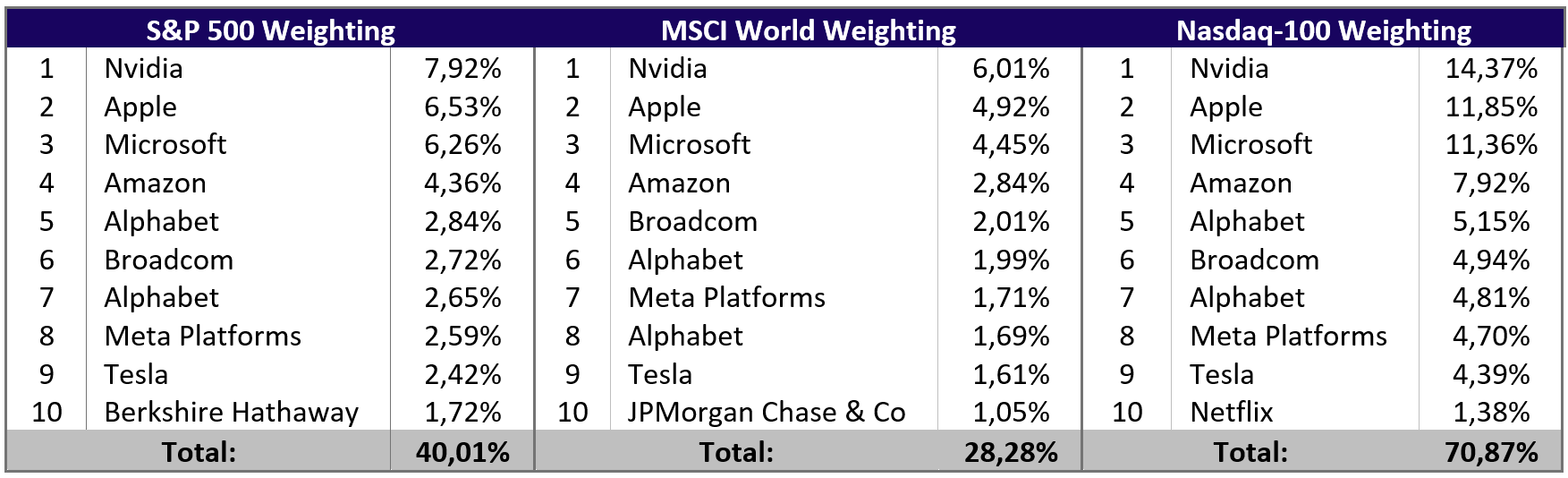
This overlap means that approximately 45% of Investor A’s total portfolio is concentrated in the same top nine companies. Furthermore, as these companies are predominantly U.S.-based technology stocks, the portfolio carries an additional layer of concentration risk — both in terms of sector and geographic exposure.
It’s important to remember that the largest companies today may not be the leaders of tomorrow. Market dynamics evolve continuously, and significant innovation is emerging from regions such as China and other developing economies, which can meaningfully influence global competition and the valuations of today’s market leaders.
The most valuable companies 25 years ago are not the same ones today.

A useful reminder of this risk is Cisco’s story during the early 2000s. At the height of the dot-com bubble, Cisco briefly became the world’s most valuable company. Today, however, it no longer ranks among the top 20 holdings in the S&P 500—demonstrating how market dominance can shift over time.
3. Blending Active and Passive Strategies to Manage Risk
Passive investing provides cost-efficient market exposure, but it is not immune to systemic market shocks. Research from Morningstar (2025) shows that over 60% of global equity ETF assets are concentrated in U.S. large-cap growth stocks, meaning these funds tend to move together during market downturns. In extreme conditions, passive ETFs may also face liquidity risk, as large-scale redemptions force passive funds to sell holdings at depressed prices, potentially widening bid-ask spreads and increasing investor losses.
One effective way to mitigate these risks is to blend multi-asset passive funds—which combine equities, bonds, and other asset classes within a single structure—with actively managed funds. This approach provides built-in diversification across multiple asset classes while remaining fairly cost-efficient. By combining multi-asset passive funds with active management, investors can enjoy the efficiency and low cost of passive exposure, while active managers help reduce over-concentration, identify undervalued opportunities and adjust allocations dynamically during periods of market stress. The result is stronger true diversification, lower correlation across holdings and better capital protection during market selloffs.
How Investonline helps you get it right
We don’t simply buy ETFs/Index Funds — we build portfolios around them intelligently.
Here’s what we do differently:
- Comprehensive exposure analysis — We look through each ETF to its underlying holdings to identify duplication and concentration.
- True diversification — We blend ETFs with active funds, bonds and money market to create genuine risk balance.
- Currency & tax alignment — We structure investments within the right vehicles (e.g. Offshore Wrappers) to minimise unnecessary tax.
- Ongoing review — We track global sector exposure, valuation shifts, and rebalance when markets change, so your diversification works when needed.
Click here to schedule a complimentary meeting with one of our Financial Planners to review your current investment portfolio and explore opportunities to optimise both your investment strategy and tax efficiency.
